Net Metering After Solar Installation: What Owners Often Miss
· 7 min read
By Marjorie F. Jetajobe
Your solar panels are installed. The inverter is running. During the day, your property is producing its own electricity.It may feel like the project is finished. But for many grid-connected solar owners in the Philippines, there is another important part of the process: What happens to the electricity your solar system produces but you do not use? That is where net metering comes in. Under the Philippine Net-Metering Program, qualified renewable-energy systems can export excess electricity to the distribution grid and receive corresponding bill credits. In the Meralco franchise area, for example, renewable-energy facilities of up to 100 kW may qualify for net metering. Meralco Understanding how this works after installation can make the difference between simply owning solar panels and properly managing a grid-connected solar investment.
Solar Installation Does Not Automatically Mean Net Metering
One of the easiest assumptions to make is that once solar panels are installed, any excess electricity sent to the grid will automatically reduce the electricity bill.That is not necessarily the case. The property must complete the applicable net-metering and interconnection process with its distribution utility. For Meralco customers, this includes documentary requirements, technical evaluation, inspection, testing and commissioning, and installation or configuration of appropriate metering equipment before exported electricity begins receiving official net-metering credits. This is why net-metering requirements should ideally be considered while the solar project is still being planned—not only after the installation crew has finished.
The Bi-Directional Meter Matters
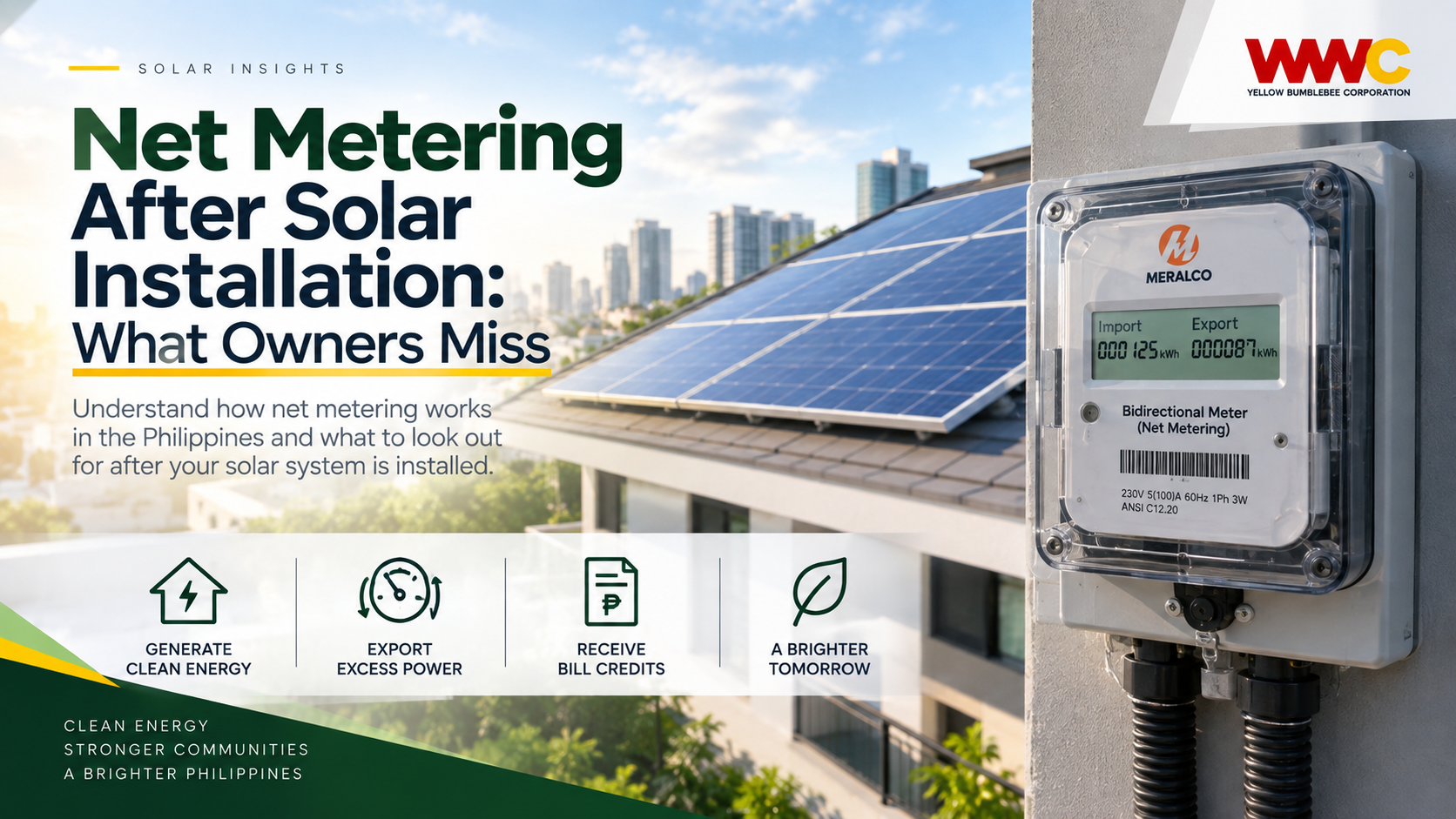
A traditional electricity meter is primarily concerned with electricity flowing from the utility to the customer.A solar property can have electricity flowing in both directions. When solar production is lower than the property's demand, electricity is imported from the grid. When solar generation exceeds the property's immediate consumption, excess electricity may flow back into the grid. A bi-directional meter records these two flows separately so the distribution utility can determine how much electricity was imported and how much was exported. Meralco warns that excess generation from a solar system without appropriate net-metering enrollment and bi-directional metering may not be recorded as the owner expects. Installing solar panels and having the proper metering arrangement are therefore two different parts of the project.
Exported Solar Is Not Credited at the Full Retail Electricity Rate
This is probably one of the most important things solar owners miss.Suppose your electricity bill shows a total effective rate per kilowatt-hour. It can be tempting to assume that every kilowatt-hour you export will receive a credit of approximately the same value. That is not how the current mechanism works. For Meralco net-metering customers, exported electricity is credited using the applicable monthly blended generation charge, excluding other generation adjustments. The full amount consumers pay for imported electricity also contains transmission, distribution, system-loss and other regulated charges. Meralco That means one kilowatt-hour of electricity you avoid buying by using your solar energy directly can have a different financial value from one kilowatt-hour exported to the grid. This distinction is important when deciding how large a solar system should be.
Self-Consumption Is Still Very Important
Imagine a solar system generating strongly at noon.If your building is simultaneously operating air-conditioning, computers, pumps, machinery or other loads, much of that solar electricity can be consumed directly on site. That reduces the amount of electricity that needs to be purchased from the grid. If the solar system produces more electricity than the building needs at that moment, the remaining electricity can be exported under an approved net-metering arrangement. Because exported electricity is not generally credited at the complete retail rate, matching solar generation with actual daytime consumption remains an important part of system design. Meralco similarly advises customers to understand their load profile and peak consumption when sizing solar installations to maximize savings. The largest possible solar array is therefore not automatically the most financially efficient system for every property.
Do Not Judge the System From the Solar Panels Alone
After installation, owners commonly look at the panels and assume that everything is working because nothing appears physically wrong.The better place to look is the data. Most modern inverters or monitoring platforms can report solar generation over the day, month and year. Owners should become familiar with their normal production pattern so unusual declines become easier to notice. Electricity bills should also be reviewed after net-metering activation. Check whether exported energy is being recorded, whether corresponding credits appear, and whether the property's grid consumption changes in a way that makes sense compared with its solar production. Meralco states that export credits begin from successful testing and commissioning and are then reflected in succeeding billing. Monitoring your system after installation is therefore just as important as monitoring it on commissioning day.
Excess Credits Can Be Carried Forward
Another misconception is that unused export credits automatically disappear at the end of every billing month.The ERC's 2025 amendments introduced banking and rollover of net-metering credits across current and future billing periods. Meralco currently states that unused net-metering credits can be carried over and do not expire under its implementation of the rules. This is particularly useful because solar generation and electricity consumption do not remain identical throughout the year. Weather, operating schedules and seasonal electricity demand can all change the balance between imported and exported electricity.
Net Metering Does Not Automatically Give You Backup Power
Solar owners can also confuse net metering with backup power.They solve different problems. Net metering determines how electricity exported to the distribution grid is measured and credited. Battery storage and properly designed backup configurations determine whether selected loads can continue operating when utility power disappears. A typical grid-connected solar installation must include appropriate protection against sending electricity into utility lines during an outage. This protects workers and prevents unsafe grid conditions. For systems incorporating batteries, Meralco specifies isolation requirements so designated battery-backed loads can operate appropriately without improperly exporting battery energy into the distribution system during battery operation. If uninterrupted power during outages is one of the owner's objectives, that requirement should therefore be discussed during system design rather than assumed to be part of net metering.
The Distribution Utility Still Needs to Evaluate the Connection
Having space for ten, twenty or fifty kilowatts of panels does not automatically mean the local distribution network can accept the same amount of export without evaluation.Distribution utilities may conduct technical studies to determine how a proposed renewable-energy system could affect their network. For Meralco applications, a Distribution Impact Study evaluates factors such as hosting capacity, power quality, safety and distribution-system limitations. Additional assessment may be required when network upgrades are necessary. This is another reason owners should coordinate their interconnection requirements before finalizing equipment and system capacity.
The Paperwork Should Not Be an Afterthought
Physical installation may be the most visible part of a solar project, but documentation is essential for completing a compliant grid connection.Depending on the distribution utility and project, requirements can include application documents, electrical plans, equipment information, local-government inspection documents, agreements, technical evaluations and regulatory compliance requirements. For Meralco customers, the current process includes a Certificate of Final Electrical Inspection from the LGU, a Net-Metering Agreement and other applicable documentation before final energization and commissioning. Requirements may differ between distribution utilities and locations, so owners should verify the current process directly with the utility serving the property.