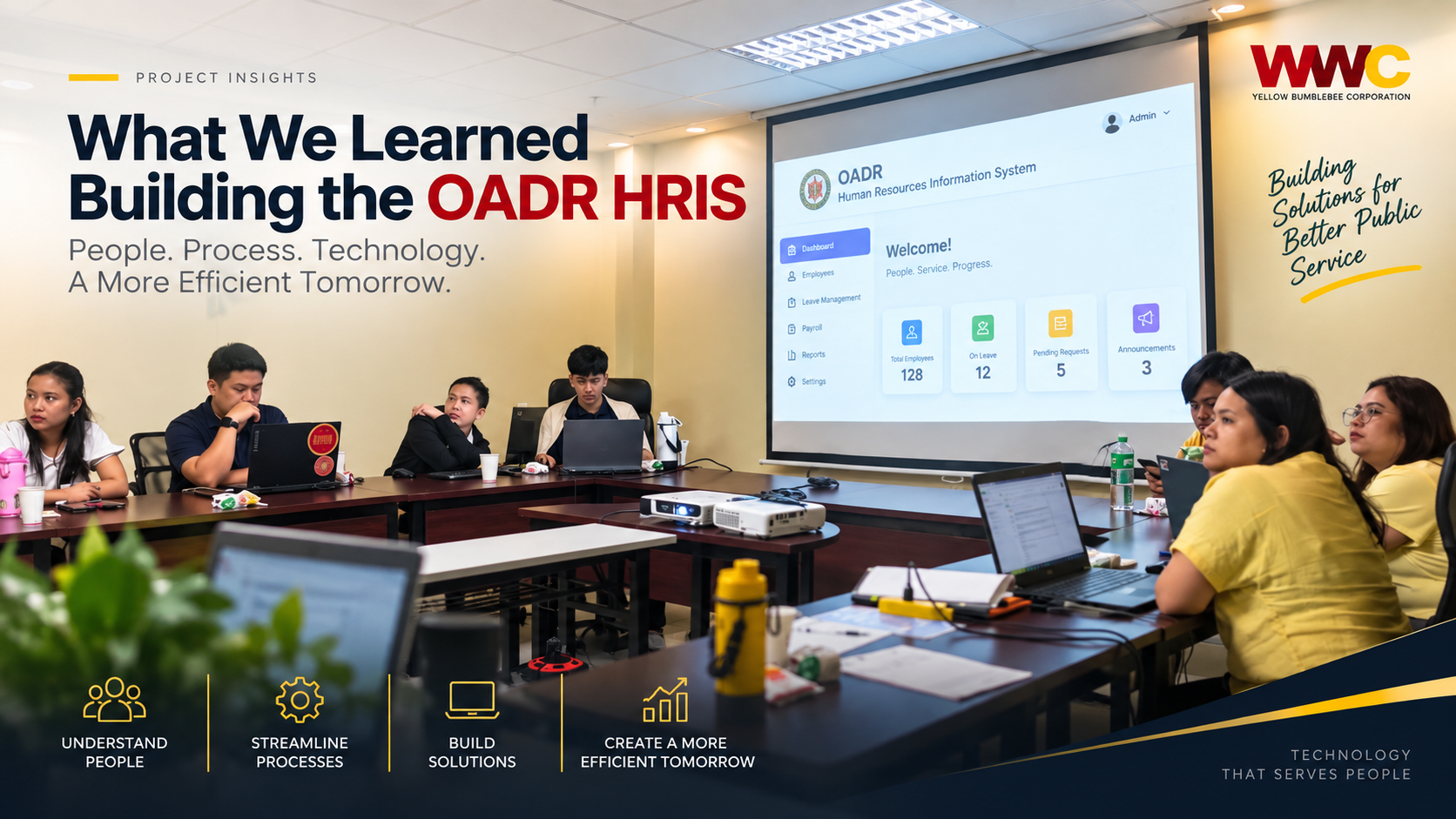
What We Learned Building the OADR Human Resources Information System
· 3 min read
By Marjorie F. Jetajobe
Building More Than an HR System
A Human Resources Information System can look straightforward from the outside.Store employee information. Process requests. Generate reports. Keep records organized. But once development begins, it quickly becomes clear that an HRIS is not simply a collection of digital forms. It is a system that connects people, policies, approvals, records, responsibilities, and day-to-day government operations. That was one of the most important lessons we took from building the HRIS for the Office for Alternative Dispute Resolution (OADR). OADR is an attached agency of the Department of Justice established under the Alternative Dispute Resolution Act of 2004. Its mandate includes promoting and developing the use of alternative dispute resolution in both the public and private sectors. Department of Justice OADR's public procurement records also identify a project for the supply, delivery, installation and configuration of a Human Resources Information System in 2025. DOJ OADR Working on a system like this reinforced several lessons that apply not only to HR software, but to almost any government or organizational information system.
- Maintain employee information in one structured systemProcess HR requests and approvals
- Organize administrative records and documents
- Generate useful reports
- Improve visibility into ongoing HR processes
- Reduce repetitive manual work
That was one of the most important lessons we took from developing the Human Resources Information System for the Office for Alternative Dispute Resolution (OADR).Working on the project reinforced lessons that apply not only to HR software, but to almost any government or organizational information system.
Understand the Workflow Before Writing the Code
A screen can be beautifully designed and technically correct while still failing to match the way people actually work. Before implementation, developers need to understand what happens from the moment a user starts a transaction until that transaction is completed.
- Who initiates the request?Who reviews it?
- Who has authority to approve or reject it?
- Does it need to pass through multiple offices or roles?
- What happens when information is incomplete?
- What should happen after approval or rejection?
- What records need to remain available afterward?
The software should reflect the real workflow rather than forcing users into an artificial process simply because that process is easier to program.
Understand the process first. Automate it second.
When requirements are unclear, writing more code rarely solves the problem. Clear workflows do.
HR Data Is Connected, Not Isolated
An employee record is rarely just a name and an employee number.Information throughout an HR system may be connected to positions, organizational units, employment history, requests, documents, approvals, attendance-related information, and other administrative records.
- Employee profilesPosition and organizational assignments
- Employment history
- Supporting documents
- Leave and other HR requests
- Approval records
- Attendance-related information
- Reports and administrative records
Technology Should Support the Organization
Perhaps the largest lesson from developing an HRIS is that successful digital transformation is not about replacing paper with screens.It is about understanding a process and deciding where technology can make that process clearer, more consistent, accessible, secure and manageable. Software cannot fix an undefined workflow simply by digitizing it. But when organizational knowledge and technical implementation are brought together carefully, an information system can become much more than a database. It can become infrastructure that supports the people doing the actual work. For the WWC development team, building the OADR HRIS was another reminder that meaningful systems are created not only by writing code, but by listening, understanding, testing, improving and designing around the people who will rely on them.